
 Cart is empty
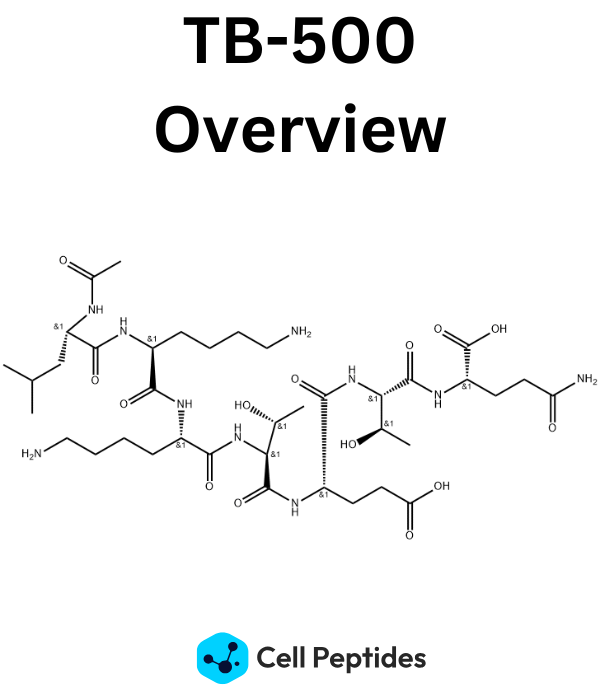
The human body is home to over 7,000 known peptides, all with different functions — but Thymosin Beta-4 (aka TB-500) is among the most abundant ones. That makes sense when you know what it does. Thymosin Beta-4 is the built-in search and rescue molecule that travels the bloodstream looking for damage to heal.
That natural peptide is fast and effective. There are, however, times when a little extra can make all the difference. TB-500, the injectable synthetic version, makes that possible. It’s been studied for everything from speeding up healing from muscle and tendon injuries to chronic disease management, and from brain protection to heart and eye health.
The thing that makes TB-500 most exciting to researchers hoping to set the stage for future clinical applications? In contrast to some healing peptides, TB-500 works systemically. A dose doesn’t stick around the injection site. It circulates around the body to home in on injuries, inflammation, and stress. TB-500 helps the body heal — even when doctors don’t quite know where healing is needed.
What is TB-500 and Its Brief History
Thymosin Beta-4 was named after the thymus gland — the small organ in the upper chest that makes and matures the T-cells that fight infections.
A research team from the University of Texas, led by Dr Allan Goldstein, found it there during their quest to better understand the immune system. They extracted a whole family of proteins from the thymus tissue of calves, but Thymosin Beta-4 got their attention because there was so much of it. At first, the team that discovered it and everyone else in the scientific field thought its role was strictly related to the immune system. And confined to the thymus.
It wasn’t.
Thymosin Beta-4 turned out to be nearly everywhere, in fact — from blood platelets to skin and muscle tissue. That had to hint at a much broader function. What that was? That was a mystery for quite a while.
The discovery that Thymosin Beta-4 manages actin was the breakthrough. This protein gives cells their structure and shape. It also builds new cells, repairs damaged tissue, and makes it possible for muscles to move — but it can’t do its job without Thymosin Beta-4 giving it directions. [((https://pubmed.ncbi.nlm.nih.gov/22074294/))]
With that cleared up, research into Thymosin Beta-4 quickly moved from immunology to healing. The synthetic version, TB-500, was developed to make studying it easier. TB-500 is good for more than finding out more about its natural counterpart, though — it also has definite clinical potential.
How Does TB-500 Work?
You know what TB-500 does now. It finds places where healing is needed — anywhere in the body — and then gets to work on making that happen. Now you want to know how. The basic answer is “by controlling actin,” but there’s more.
- TB-500 attaches itself to actin molecules to confine them to a “stand-by” state where they don’t do much but vigilantly wait for further orders.
- When an injury or other kind of damage hits, TB-500 sends the actin molecules out to make filaments that push cell membranes forward.
- Other cells — like fibroblasts and keratinocytes — can then quickly get to the damaged area to begin healing and fixing things up.
If that still sounds abstract, here’s what that process results in. TB-500 gets new blood vessels built so healing tissues can get more oxygen and nutrients. It combats inflammatory cytokines to slash destructive inflammation and get the healing phase of injury going faster. It gives stressed cells a little survival signal that decreases the rate of cell death, and helps preserve tissues after seriously-threatening health crises like heart attacks and strokes. Finally, TB-500 helps other repair cells move more easily, so collagen gets deposited to make strong, functional tissue healing possible.
TB-500 is often called a “healer,” and indeed, we’ve said it ourselves. That’s not inaccurate, but it doesn’t quite describe how the peptide works. TB-500 is a healer in pretty much the same way as a doctor prescribing medicine — it “orders” the start of the process.
What Applications Has TB-500 Research Looked at So Far (and What Could Be Next)?
A peptide that promotes cell migration and survival, works systemically, and has potential applications with regard to any tissue type that can repair itself? You bet that researchers from all sorts of fields have been all over it. The most interesting findings so far might surprise you.
Sports Medicine Applications in Muscle, Tendon, and Ligament Healing
A massive number of rat and mouse studies demonstrate that TB-500 speeds up the healing of muscle, tendon, and ligament injuries — often frustratingly slow to repair. The mechanism is clear. TB-500 sends fibroblasts and satellite cells to the site to kick natural healing processes up a few notches. The potential for reduced downtime is clear when muscle fibers and collagen can heal and rebuild faster and less chaotically, but the possibility that “extra help” from TB-500 improves the quality of the healing process is even more interesting. [((https://www.sciencedirect.com/science/article/abs/pii/S0167011513000645)), ((https://cshperspectives.cshlp.org/content/14/8/a041235.short))]
TB-500 for Skin Healing — Burns, Surgery, and Ulcers
The skin, the single largest organ, is uniquely at risk of wounds. That’s true in the case of chronic conditions, but also in completely healthy people. Does TB-500 have any potential applications here, as its ability to trigger the building of new blood vessels and heal cells would suggest? Animal studies looking for answers are in full swing. They have been for a while. Research so far has shown that the potential isn’t limited to one type of skin wound. [((https://www.sciencedirect.com/science/article/abs/pii/S1046592807001891)), ((https://www.tandfonline.com/doi/full/10.2147/DDDT.S50183)), ((https://onlinelibrary.wiley.com/doi/abs/10.1002/term.2028))]
That raises the exciting possibility that TB-500 could be used to help people with burns, people recovering from surgery (and the incisions it brings), and even long-term, festering wounds with a high infection risk, like diabetic ulcers. And beyond the skin? Thymosin Beta-4 has made researchers studying corneal damage and other eye injuries very excited, too. [((https://www.tandfonline.com/doi/full/10.2147/opth.s12160046))]
Thymosin Beta-4 and Scar Reduction (Beyond the Skin)
The prospect of reduced scarring is obviously welcome to people who’ve suffered skin injuries, but far more dangerous scars exist. They impact internal organs — the heart after a heart attack, for example, and livers affected by fibrosis. If TB-500 could, as a lab-created version of Thymosin Beta-4, help facilitate the development of more pliable, more functional scarring, that could save a lot of lives. TB-500 isn’t anywhere near prescription-ready yet, but research investigating the possibility is ongoing. [((https://www.sciencedirect.com/science/article/abs/pii/S1567576922011134)), ((https://www.mdpi.com/1422-0067/16/5/10624))]
Research Into Potential Roles in Healing From Traumatic Brain Injury and Stroke
We told you TB-500 is a systemic peptide. What applies to the heart and liver also applies to the brain, and exciting early studies looking at “neurorestoration” — brain healing — after traumatic brain injury have found potential. TBI recovery is long, hard, and incomplete. TB-500 is a very interesting treatment candidate. [((https://nyaspubs.onlinelibrary.wiley.com/doi/abs/10.1111/j.1749-6632.2012.06683.x))]
Rat studies have found the peptide has promise with regard to stroke recovery, too, but it might not be necessary to wait until restoration is needed. In aged rats, the Thymosin Beta-4 protects the brain so it might never come to a stroke. [((https://www.tandfonline.com/doi/abs/10.1080/14712598.2018.1484100))]
These potential applications are among the most exciting — because they have clear real-life benefits. There are others, though, and future TB-500 research is very likely to discover other healing benefits in completely different areas.
How Is TB-500 Administered in Research Settings?
TB-500 is meant to move around freely, so it can find and heal injuries. That systemic role dictates the best delivery method, and it makes subcutaneous injection the preferred route. Once TB-500 enters the bloodstream, there’s the advantage that the peptide can make its way to injuries — those that have already been identified, but also those that haven’t.
Some studies might target specific and known localized injuries such as to a tendon in a rat’s leg. In those cases, intramuscular injection is another potential delivery route. Even localized injection is still likely to cause systemic effects, however.
It’s also interesting to know that TB-500 ships in lyophilized form, as a powder. Researchers have to reconstitute it with a sterile solvent before administration for that reason. Cost and efficiency make bacteriostatic water the solvent of choice. It allows researchers to store the peptide and use it for multi-dose applications.
How Do Researchers Determine Dosing Protocols for TB-500 & What is Its Common Dose?
Dosing is fairly standardized for some peptides, and hormone peptides like Sermorelin are a case in point. TB-500 is a different story. Optimal dosing depends entirely on two things — the model and the nature of the injuries the study targets, including the severity and tissue type.
Despite that, the approach to developing dosing protocols is consistent. It’s usually a two-phase process:
- Higher initial doses — like 5 to 10 mg per kilo in rodent models — are used as a “loading phase” to saturate receptors and get the healing process going.
- Researchers then switch gears toward lower doses (for instance, 2 to 5 mg per kilo) to extend the healing action.
- But in reality, various biohackers and longevity community use ~1-2mg per week split into ~2 doses.
The first phase usually relies on injections two to three times a week. Maintenance doses for the remainder of the study are less frequent at once to twice weekly, and this might continue for several months when chronic conditions are studied.
What About Contraindications?
TB-500 has the same functions as natural Thymosin Beta-4. Cell growth and supercharged blood vessel development are two of them. That’s welcome in many cases, because it speeds up wound healing and injury recovery, but there are exceptions.
Cancer needs blood vessels for nutrients too, and cell growth signals could risk speeding up its growth. Subjects with active cancer (or a history thereof) are therefore excluded from studies.
It’s also not clear how TB-500 would affect unmanaged cardiovascular conditions, because of the peptide’s known ability to stimulate blood vessel development.
Subjects in preclinical studies generally react well to TB-500 — good news, but every study design does need to take these risks into account when deciding on subject selection.
FAQs
They both have healing applications, but work very differently. TB-500 is a systemic peptide that circulates freely to target inflamed and injured areas for healing. BPC-157 works more locally, and strongly boosts ligament, tendon, and muscle healing through growth factors. Study designs that combine the action of TB-500 with the BPC-157 could be very interesting.
That possibility is quite logical, but there isn’t yet any clear evidence in this direction. TB-500 does boost keratinocyte migration, so future studies might demonstrate this potential — most likely as a secondary benefit, because hair growth isn’t a logical research endpoint.
The answer is essentially yes. TB-500 is the natural peptide present in cells all over the body, and TB-500 is the lab-created version. The number 500 doesn’t mean there’s a structural difference. It’s simply the designation for the synthetic but otherwise functionally identical compound.
Preclinical studies find this peptide to be well-tolerated on the whole. Side effects are mainly related to the route of delivery. Subcutaneous injection can always cause irritation at the site. Some lightheadedness can be associated with the vasodilation that TB-500 causes.
It does! Angiogenenesis is the creation of new blood vessels from existing ones, and it’s one of the main effects of TB-500. That’s important for tissue healing, because new blood vessels bring more nutrients and oxygen to the area — needed for faster repair.
Thymosins are any peptides isolated from the thymus, although as we’ve seen with TB-4, that doesn’t mean they’re only in the thymus. There’s quite a range of these peptides, and they all have different effects. For example, Thymosin Alpha-1 might have applications in fighting viral infections.


